towns along the basque coast
Visit the Best Towns along the French Basque Coast

Visit these towns along the French Basque Coast

France’s Atlantic coastline changes dramatically as it approaches the Spanish border. The enormous beaches of the Landes gradually give way to rocky headlands. Behind them, the first mountains of the Pyrenees rise from an intensely green landscape.

This is the French Basque Coast, or Côte Basque — a relatively short stretch of coastline encompassing glamorous seaside resorts, former fishing villages, surfing beaches, dramatic cliffs and one of the most beautiful bays in France.

From Anglet to Hendaye, the entire coastline can be explored in a few days. 

Anglet

Immediately north of Biarritz, Anglet marks the beginning of the Basque coast.

Its coastline is dominated by long sandy beaches rather than the rocky coves found farther south. Eleven beaches extend for several kilometres, making this one of the region’s principal surfing destinations.

The seafront remains relatively undeveloped in places, with dunes, coastal vegetation and walking and cycling routes separating parts of the beach from the town.

Anglet is less about sightseeing than enjoying the Atlantic itself.

Best for: surfing, cycling and long beach walks

Biarritz

biarritz photo

If one place embodies the glamour of the French Basque coast, it is Biarritz.

The transformation began during the 19th century when Empress Eugénie, wife of Napoleon III, chose the former fishing town as a summer retreat. European aristocracy followed, and Biarritz developed into one of France’s most fashionable seaside resorts.

The Grande Plage stretches beneath elegant buildings and the Hôtel du Palais, while the striped beach tents and casino preserve something of the atmosphere of the classic European resort. Today Biarritz is also one of Europe’s great surfing centres.

Walk south and the coastline becomes increasingly rocky. Paths lead past the old Port des Pêcheurs towards the Rocher de la Vierge, a rocky outcrop reached by a footbridge above the Atlantic.

Continue towards the Côte des Basques for one of the finest views in town.

Côte des Basques

Although technically part of Biarritz, the Côte des Basques deserves separate mention.

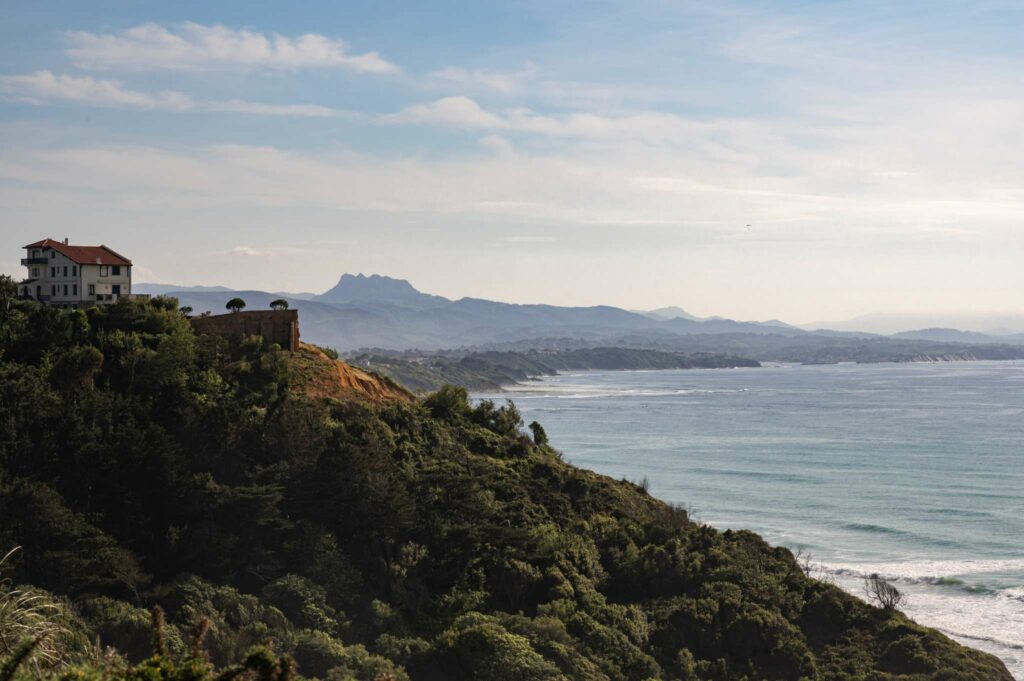
This sweeping beach beneath high cliffs occupies an important place in European surfing history and remains one of Biarritz’s most atmospheric locations. At low tide, a broad sandy beach appears beneath the cliffs. As the tide rises, much of it disappears. The view south is magnificent: on clear days the outline of the Pyrenees appears beyond the coast.

Bidart

Leaving Biarritz behind, the landscape quickly becomes quieter. Bidart sits on cliffs overlooking a succession of beaches and rocky coves. The village centre itself is slightly inland, centred around its church and pelota court, while pathways lead towards viewpoints above the sea.

Several beaches lie below, including Plage d’Ilbarritz, Plage du Centre and Plage de l’Uhabia. This is also where walking becomes one of the best ways to experience the coast.

Sections of the Sentier du Littoral follow the shoreline southwards, repeatedly revealing views across cliffs and beaches.

Guéthary

A few kilometres farther south lies Guéthary, one of the prettiest places on the entire Côte Basque. Its small harbour is a reminder of its maritime past, when local fishermen headed into the Bay of Biscay.

Today the village is known for something different: surfing.

Offshore reefs produce powerful waves that have made Guéthary legendary among experienced surfers. From viewpoints around the village, it is possible to watch them far below.

Walk down to the harbour, explore the little coves and then return to the terraces above the ocean for sunset.

Saint-Jean-de-Luz

After the exposed surf beaches farther north, arriving in Saint-Jean-de-Luz feels remarkably different.

The town curves around a sheltered bay protected by sea walls, creating much calmer water than at Biarritz. A broad sandy beach occupies the centre of the bay, backed by traditional houses and a promenade. Behind it, narrow streets lead into a lively historic centre filled with shops, bakeries and restaurants.

Saint-Jean-de-Luz also has an important place in French history. In 1660, Louis XIV married Maria Theresa of Spain in the town’s Church of Saint-Jean-Baptiste, helping seal the peace between France and Spain.

The fishing harbour remains one of the prettiest parts of town, particularly where colourful boats sit beneath traditional Basque houses.

For one of the best views, walk along the waterfront towards Sainte-Barbe, from where the entire bay opens below.

Socoa

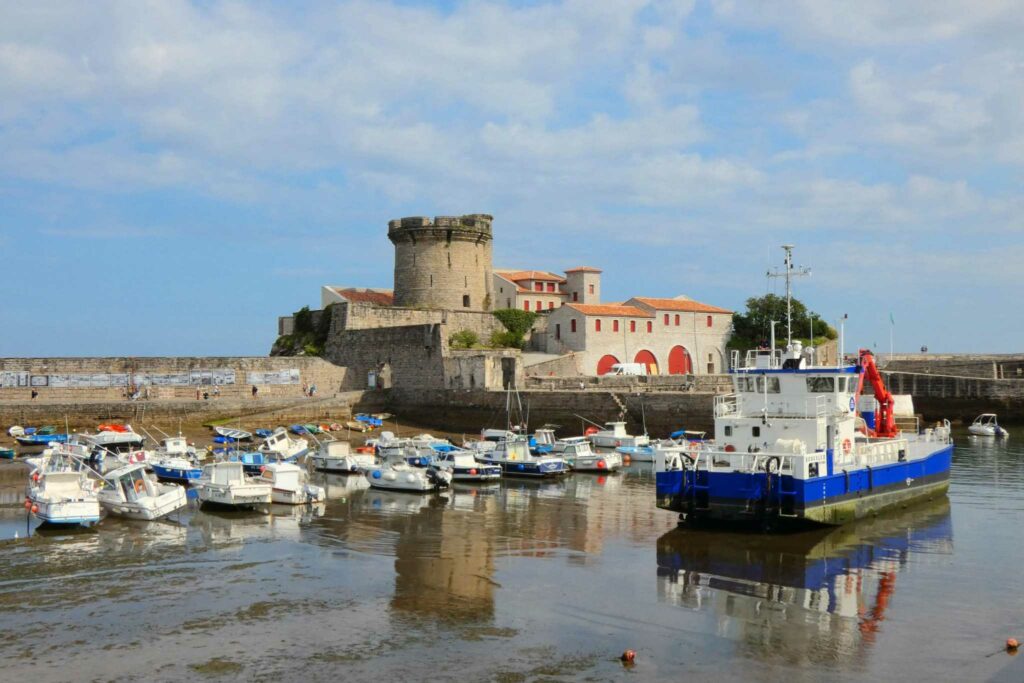
At the western entrance to the bay, Fort de Socoa forms one of the most recognisable sights around Saint-Jean-de-Luz. The fortress has origins in the reign of Henri IV and was subsequently developed under Louis XIII and later strengthened as part of France’s coastal defences. Below it lies a small sheltered beach and harbour.

From Socoa, you can look directly across the bay towards Saint-Jean-de-Luz and the mountains beyond.

The Corniche Basque

Between Socoa and Hendaye stretches one of the most beautiful landscapes in the French Basque Country: the Corniche Basque.

There are Green fields which roll towards cliffs above the Atlantic, while the Pyrenees are increasingly prominently inland. The geology is particularly striking. Layers of sedimentary rock have been folded and tilted over millions of years, producing dramatic formations visible along the cliffs and shoreline.

Rather than treating the Corniche simply as the road between Saint-Jean-de-Luz and Hendaye, allow time to explore it. Viewpoints reveal waves breaking against cliffs below, while paths cross a landscape that feels surprisingly rural considering Biarritz is less than an hour away.

It is arguably the most spectacular stretch of the French Basque coast.

Hendaye

Almost three kilometres of sand curve around a broad bay close to the Spanish border. Because the beach is relatively sheltered, its waves are generally more approachable than those around Biarritz and Guéthary, making Hendaye a popular place to learn to surf.

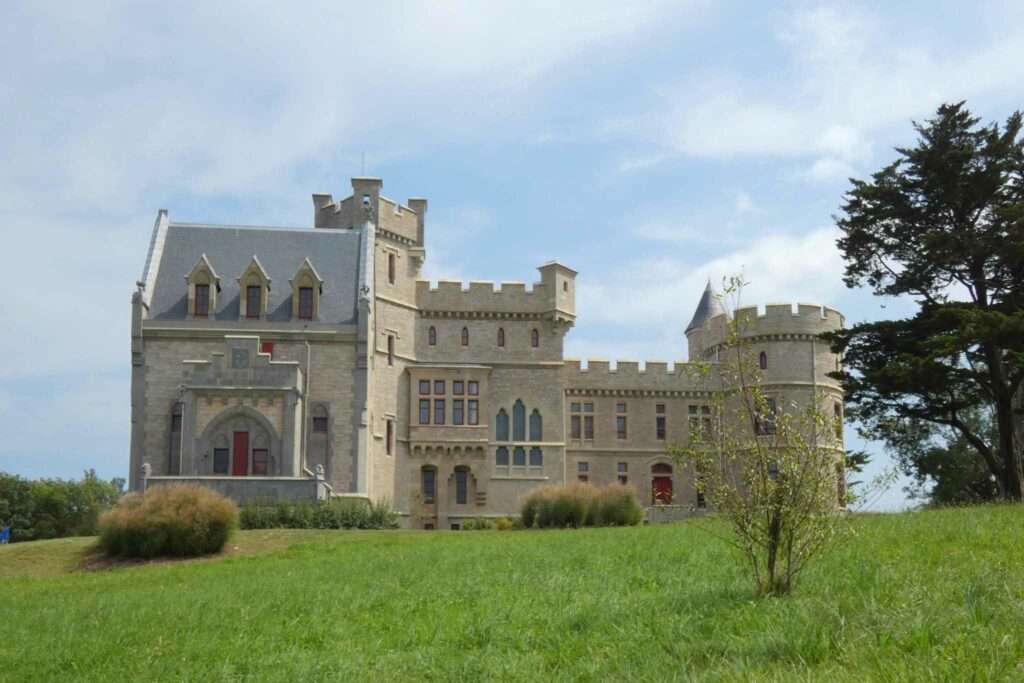
At the northern end of the beach stand the Deux Jumeaux, two distinctive rocks rising from the sea beneath the cliffs of the Domaine d’Abbadia.

Walk south and the Bidasoa estuary eventually marks the frontier between France and Spain. You can see Hondarribia, Spain directly across the water.

Leave a Reply

Your email address will not be published. Required fields are marked *

X